Case Study
IRIS
Personal orchestration for bounded agents.
A personal agent orchestration system that organizes attention, coordinates specialist work, and governs actions through human oversight.
Private system. Public architecture showcase with synthetic examples, currently published as JARVIS OS.
Independent system design across attention, agent coordination, memory, action policy, observability, evaluation, and recovery.
Case Snapshot
The strategic brief
The problem, the system response, the available proof, the strategic value, and the intentional boundary.
- 01Problem
- Commitments spread across calendar, email, tasks, and projects make it difficult to decide what deserves attention and what can safely be delegated.
- 02System
- An evidence-backed attention pipeline feeds a prioritized work queue and bounded specialists. Action proposals pass through policy, approval, execution, and verification.
- 03Proof
- A public architecture edition with re-authored documentation, illustrative TypeScript contracts, and synthetic walkthroughs. It is not the full private runtime.
- 04Value
- Connects prioritization and agent work with explicit authority, inspectable state, and recovery rather than unbounded autonomy.
- 05Limitation
- Personal integrations, production policies, and private data remain private. Public examples demonstrate design, not independently measured production reliability.
01
Attention before execution
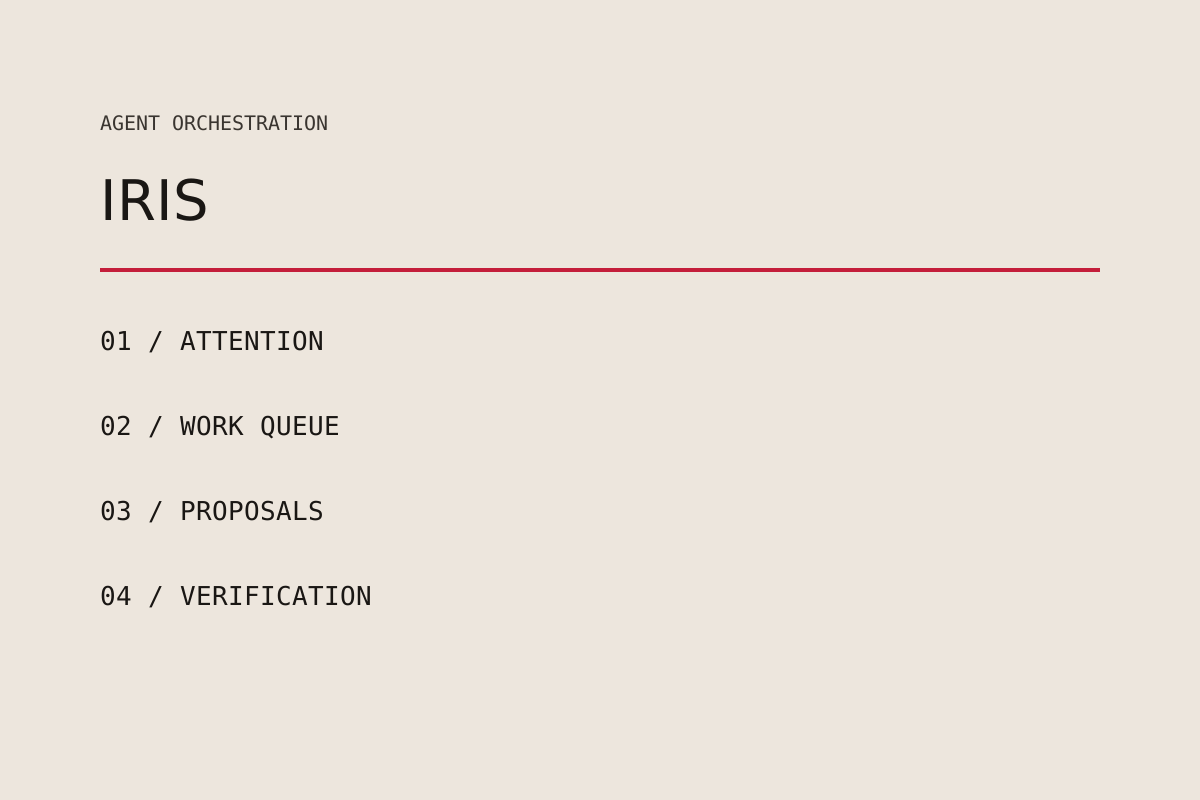
IRIS begins with the question of what needs attention. Its documented pipeline collects and filters context, removes duplicates, scores evidence, and validates bounded synthesis before placing work in P0 to P3 priority bands.
02
Specialists share a governed work queue
Management, research, analysis, planning, critique, lead scoring, CRM, and code roles have distinct responsibilities. The public design separates proposing an action from authorizing it. One router and one action pipeline keep tools, autonomy controls, and trace events under a common policy.
03
Memory carries provenance
Working, episodic, semantic, and procedural memory have different lifecycles. Records carry scope, provenance, time, and confidence. Durable memory is proposed for human review; a remembered fact cannot independently turn itself into an urgent task or widen agent permissions.
04
Execution needs a separate verification step
The recovery model distinguishes preparation, execution, verification, safe retry, rollback, and escalation. Expired approvals and stale context stop consequential actions. Evaluation scenarios cover grounding, degraded sources, approval enforcement, injection resistance, and recovery. These are documented evaluation contracts; no pass rate is claimed here.
05
A public window into a private system
IRIS is the portfolio name for the project currently published as JARVIS OS. The linked repository is an architecture and engineering showcase: documentation, illustrative contracts, and fully synthetic examples. The full implementation and personal integrations remain private. The public edition does not prove deployment maturity or autonomous operation.