RM
Back to case studies

Internal AI Strategy Workspace

Campaign Sandbox

A bounded AI workflow for moving from messy campaign briefs to structured strategy.

Campaign Sandbox turns messy campaign briefs into structured creative routes, synthetic audience simulations, risk reviews, execution plans, and exportable strategy reports.

AI WorkflowsCreative StrategyNext.jsTypeScriptOpenAIEvaluation & Guardrails
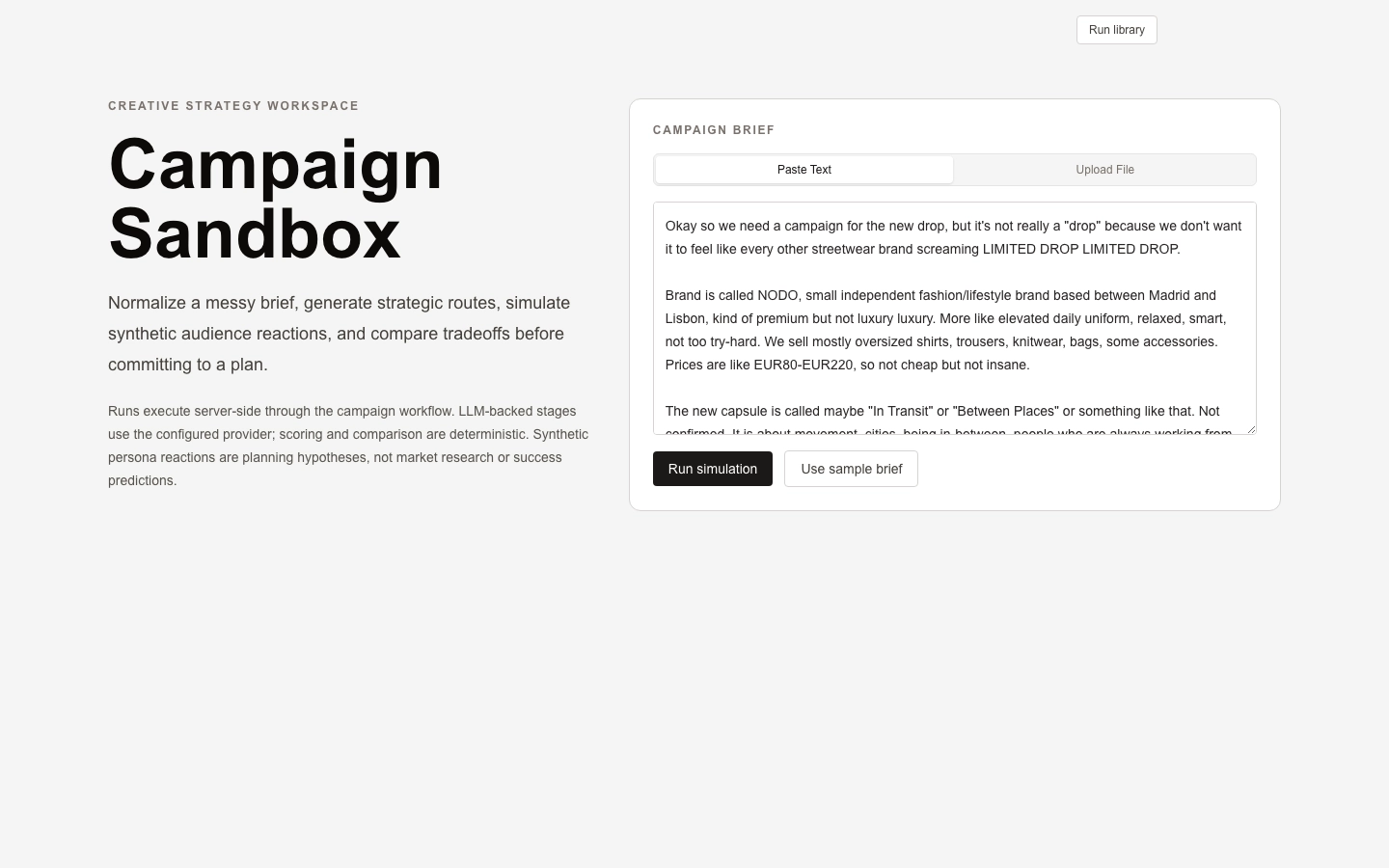
Campaign Sandbox brief intake screen
Campaign Sandbox intake and strategy workspace.

Project snapshot

What the system is

Role

Product design, AI workflow architecture, full-stack implementation

Type

Internal AI tool

Stack

Next.js, TypeScript, React, Zod, OpenAI structured outputs, deterministic validation

Status

Finished internal v1

Problem

Strategy starts with fragmented inputs.

Early campaign strategy work often starts with client notes, product claims, creative mandatories, audience assumptions, launch constraints, and unclear positioning.

The challenge was to turn those inputs into structured campaign thinking without pretending to replace strategy, market research, or creative judgment.

The core design constraint was reliability: the system had to be useful without becoming an uncontrolled autonomous agent.

Not an autonomous agent. A bounded strategy workflow.

Objective

Move from brief to strategy faster while keeping judgment human.

  • Accept pasted or uploaded brief material.
  • Structure the brief into usable campaign inputs.
  • Generate differentiated route territories.
  • Simulate synthetic audience reactions for planning only.
  • Score and compare routes deterministically.
  • Add a Creative Director Review layer.
  • Preserve human route selection.
  • Generate a practical execution plan.
  • Export Markdown, HTML, and PPTX reports.
  • Keep access password-protected when deployed.

Architecture decision

A hybrid workflow-agent architecture.

Bounded LLM stages handle interpretation, synthesis, and critique. Deterministic code handles routing, schemas, validation, scoring, access control, proof checks, exports, and safety boundaries.

01Brief intake02Brief normalization03Strategic tension extraction04Campaign route generation05Persona generation06Synthetic audience reactions07Deterministic scoring08Pre-mortem risk review09Deterministic comparison10Creative Director Review11Human route selection12Execution plan13Deterministic export

Campaign strategy requires judgment and synthesis.

Reliability requires deterministic boundaries.

Route selection should remain human-controlled.

Synthetic reactions must not be treated as research.

Exports should be deterministic and auditable.

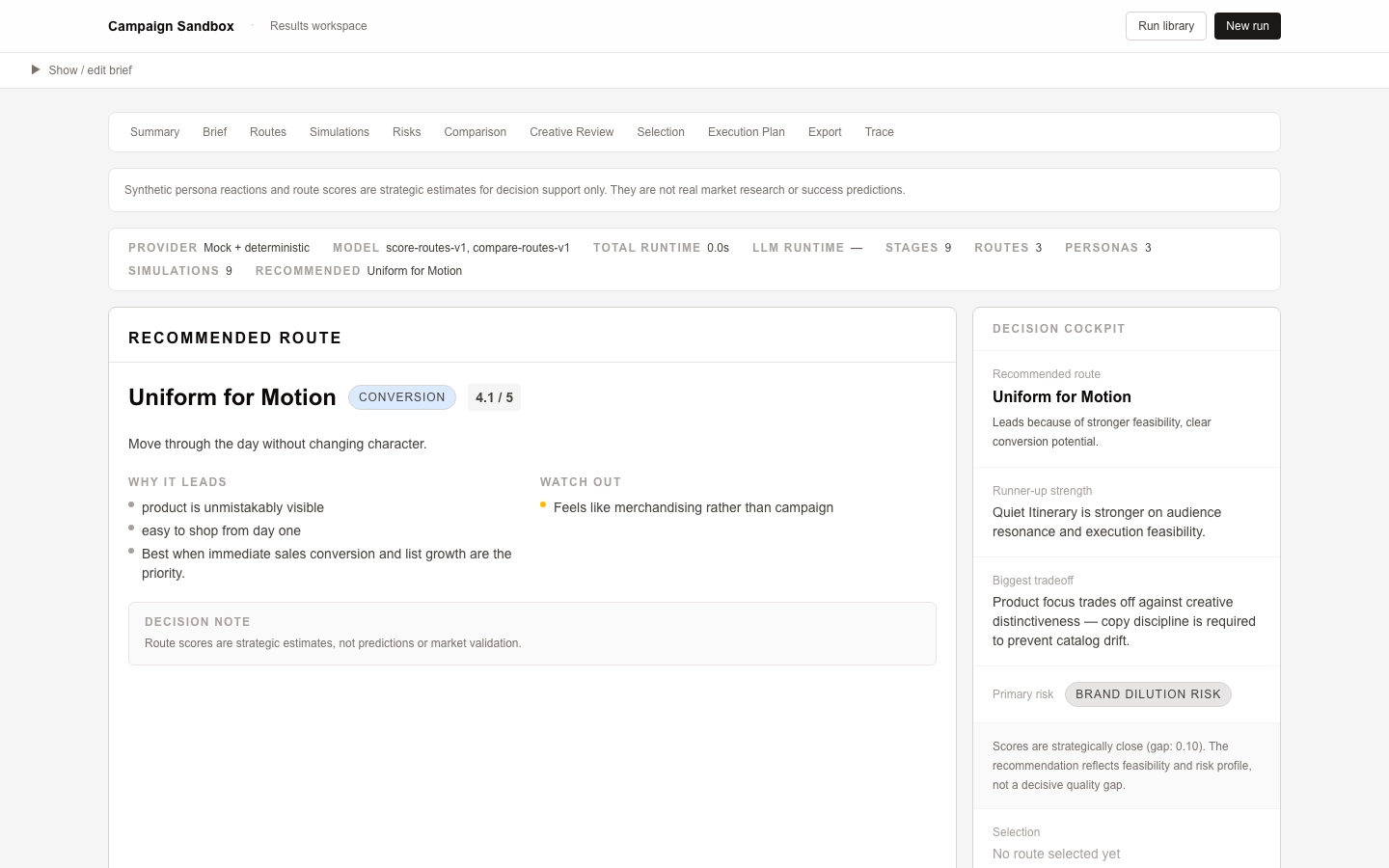
Workflow / Decision cockpit

Make route tradeoffs visible before selection.

The Decision Cockpit summarizes the recommended route, runner-up strength, biggest tradeoff, primary risk, close-score warnings, and selection or export status.

Campaign Sandbox decision cockpit
Decision cockpit summarizing the recommended route, tradeoffs, risk, and route status.

Route development

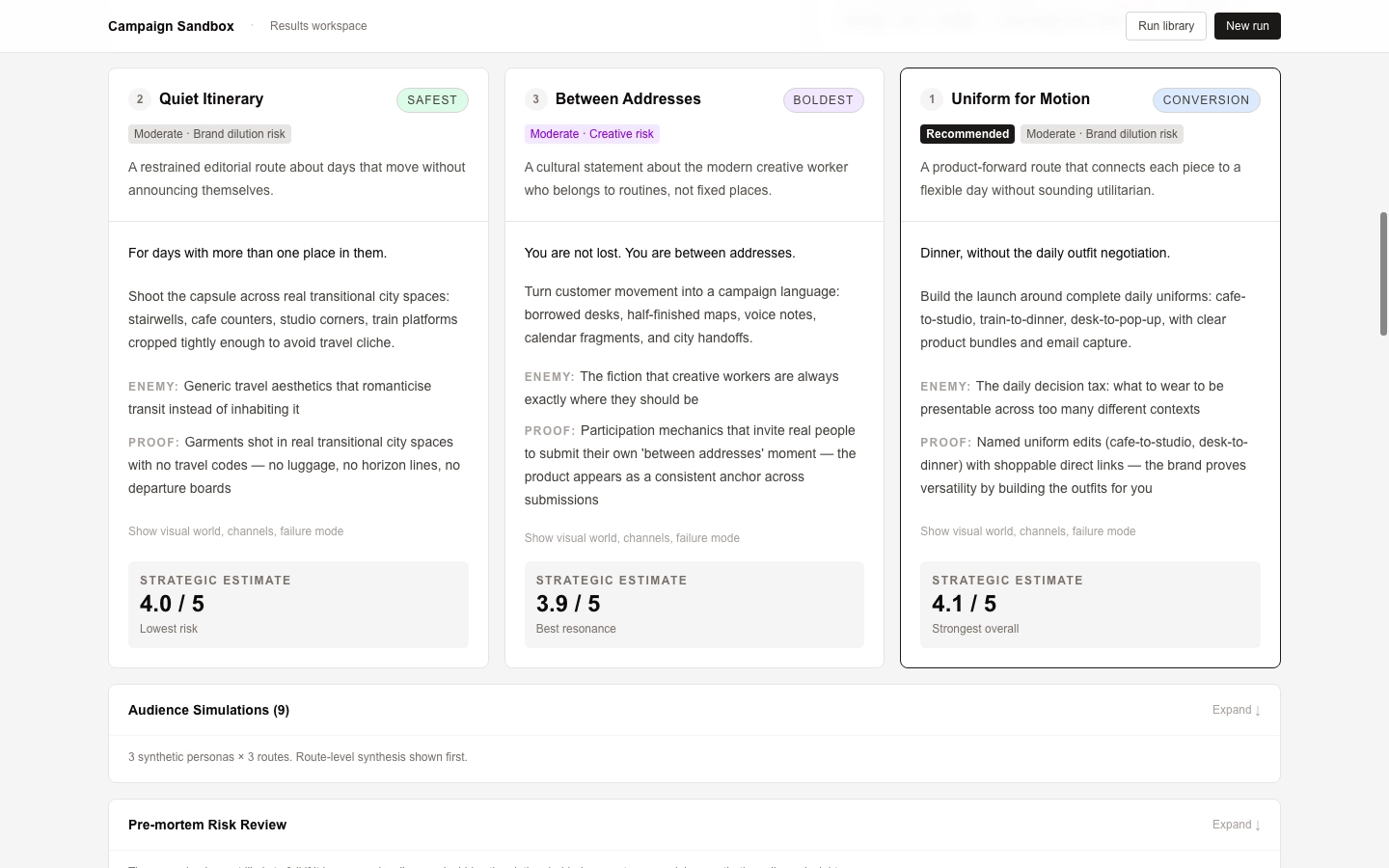
Three territories, each with a strategic job and failure mode.

Every route includes a name, strategic role, killer line, enemy, proof mechanism, visual world, channel fit, failure mode, and strategic estimate.

Campaign Sandbox generated campaign route cards
Generated campaign territories with scoring, positioning, proof mechanism, and route risks.
Synthetic audience reactions are planning hypotheses, not market research.

Creative review

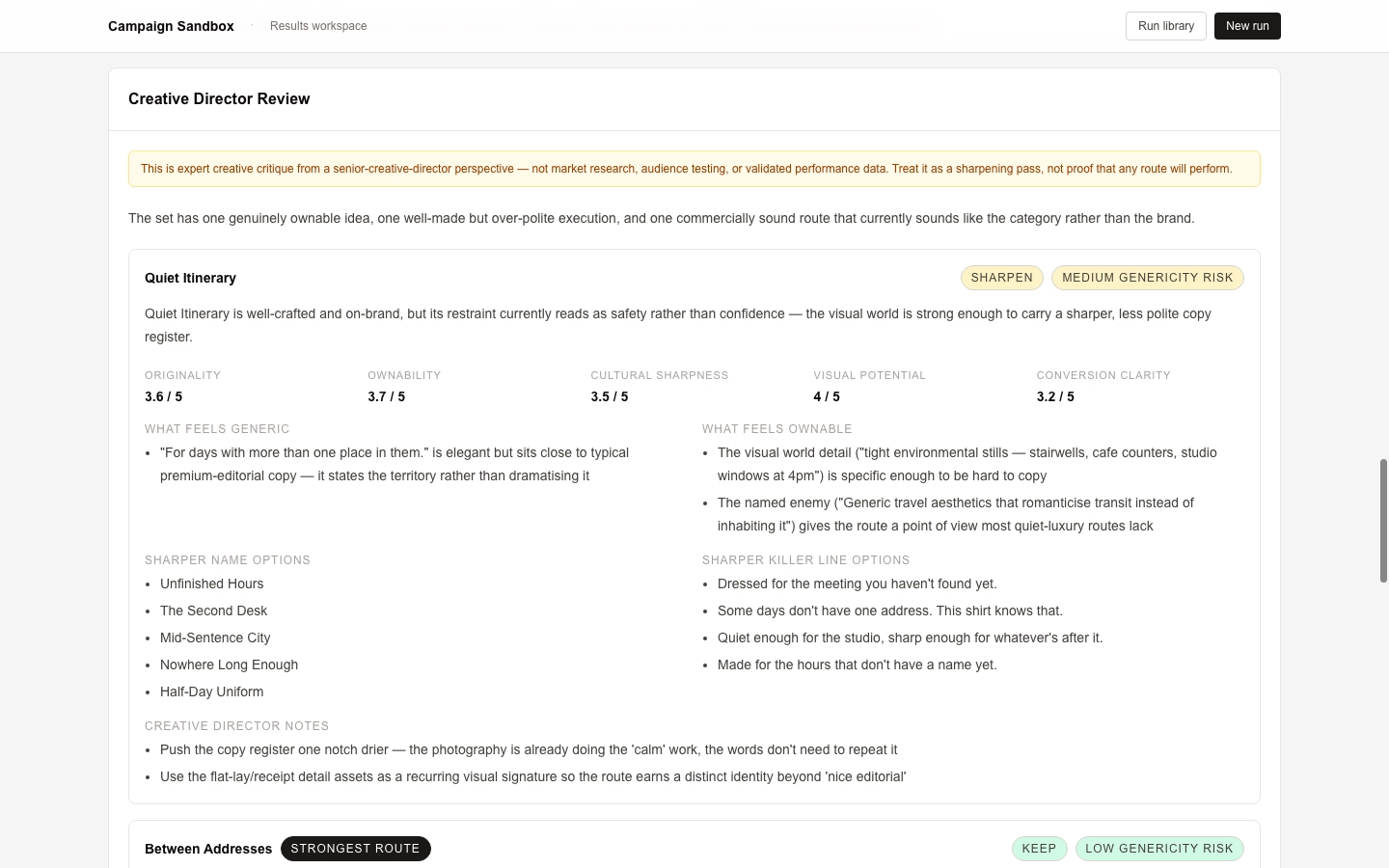
A critique layer focused on distinctiveness, not approval.

Creative Director Review examines originality, ownability, cultural sharpness, visual potential, conversion clarity, and genericity risk. It also proposes sharper route names, killer lines, and route-level notes.

Campaign Sandbox Creative Director Review
Creative Director Review critiques originality, ownability, cultural sharpness, and genericity risk.

Key features

Each stage narrows uncertainty without hiding it.

Structured brief intake

Users can paste a campaign brief or upload supported files. Extracted text is shown in an editable preview before the workflow runs. TXT and PPTX are supported reliably; PDF extraction is labeled honestly because results can vary by file and environment.

Strategic tension

The system identifies audience desire, audience resistance, the brand proof challenge, the creative trap, the creative opportunity, and a campaign tension statement.

Synthetic audience signals

Synthetic personas react to each route as planning hypotheses only. They are never presented as research, survey data, focus-group findings, or performance predictions.

Deterministic comparison

Rules provide route tradeoffs, feasibility estimates, risk categories, close-score warnings, and recommendation logic without claiming predictive accuracy.

Human route selection

The workflow stops before final execution so the user, not the model, chooses which strategic territory should move forward.

Local run library

Saved runs support internal reuse and comparison while remaining in browser storage rather than a server database.

Execution

Turn the selected route into a practical campaign system.

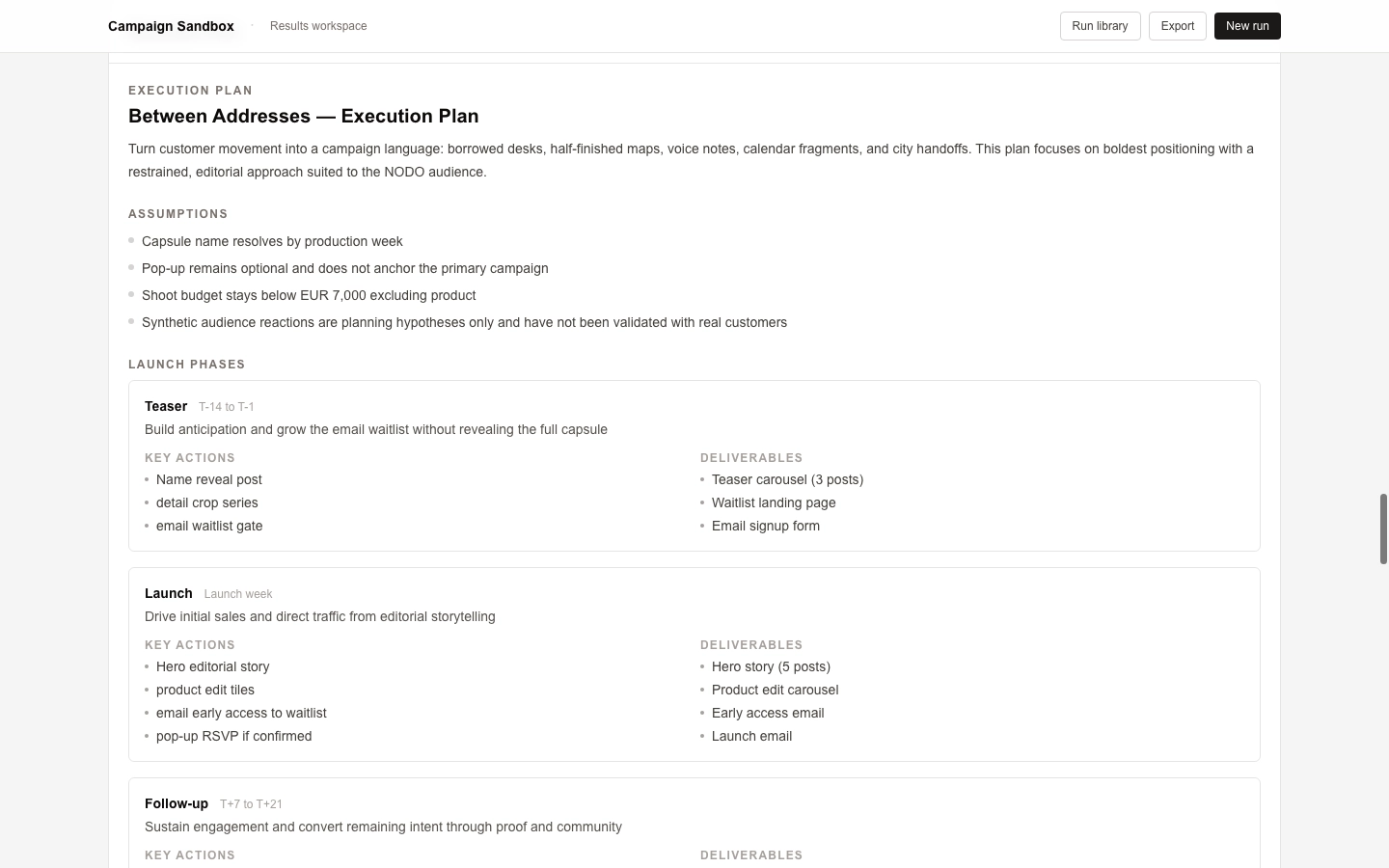
After manual route selection, the workflow generates a campaign spine, launch plan, channel system, production system, copy system, measurement system, claims and legal review, and next actions.

Campaign Sandbox execution plan
Selected route expanded into an execution plan, channel system, production system, copy, measurement, and legal review notes.

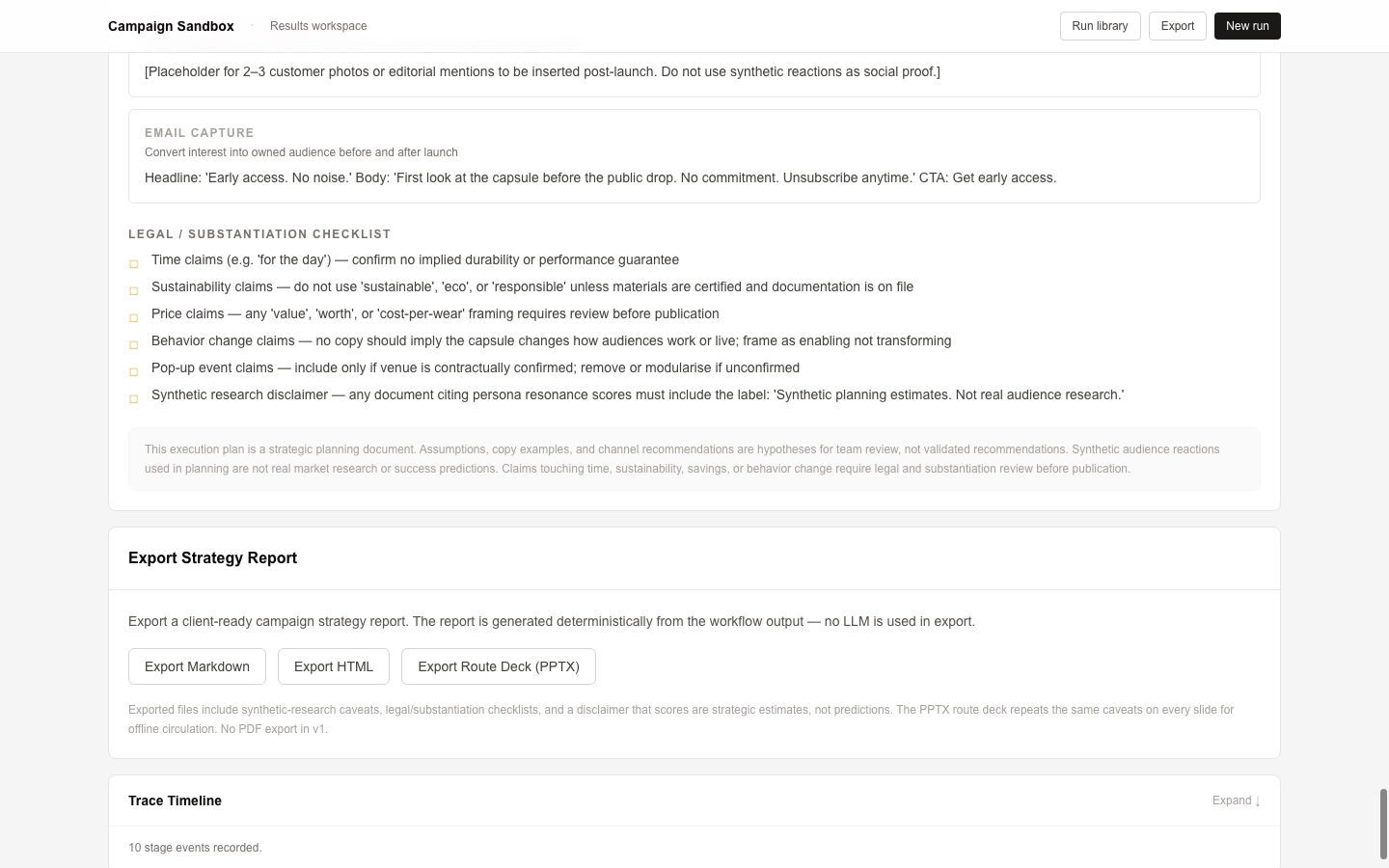
Export system

Structured output becomes a deterministic artifact.

Markdown reports, HTML reports, and PPTX route decks are generated directly from validated workflow output. No LLM is used during export generation.

Campaign Sandbox export panel
Deterministic export to Markdown, HTML, and PPTX route deck.

Reliability and safety design

Controlled AI use instead of uncontrolled autonomy.

Proof integrity guardrails block unsupported testimonials, fake user-generated content, and unsubstantiated performance claims unless the source brief provides support.

Server-side LLM calls onlyOpenAI structured outputsZod schema validationDeterministic route scoring and comparisonRoute quality validationProof integrity guardrailsRetry-once repair for quality failuresSynthetic research caveatsHuman route selectionDeterministic exportPassword-gated deploymentNo raw prompt or provider-output exposureNo client-side API key exposure

Password-protected deployment

The repository is public, but a deployed operating surface should remain behind an internal password gate because using the app can trigger server-side LLM calls.

Technical stack

A typed application with deterministic boundaries.

Next.jsTypeScriptReactZodOpenAI structured outputsLocal browser storageMarkdown exportHTML exportPPTX exportVitestMiddleware password gate

Outcome

Finished internal v1.

Campaign Sandbox is suitable as an internal strategy accelerator and a portfolio case study in reliable AI workflow design.

  • 854 tests passing across 47 files
  • Clean typecheck and lint
  • Production build passing
  • Password gate tested
  • Campaign APIs blocked without access
  • Markdown, HTML, and PPTX exports working
  • GitHub repository reviewed for public safety

What I learned

The most important decision was making the system more bounded.

Useful AI systems need deterministic routing, schema validation, explicit safety boundaries, human approval points, quality gates, traceable stages, clear caveats, and controlled access.

The strongest version is not an autonomous marketing agent. It is a structured workspace that accelerates strategy while keeping the human responsible for judgment.

Limitations / Final status

Built for internal work, not SaaS.

  • Synthetic audience reactions are not real market research.
  • PDF extraction may vary by file and environment.
  • Saved runs are browser-local.
  • The deployed app uses a shared password gate, not user accounts.
  • There is no rate limiting yet.
  • Outputs should be reviewed before external or client use.
  • The tool is built for internal work, not SaaS.