Case Study
HALO Control
One control plane for local AI workloads.
A local AI control plane that gives an AMD Halo workstation a model inventory, capability routing, workload authorization, telemetry, and activity history.
Public architecture edition. Target hardware and real model inference are not yet verified.
Independent system architecture, control-plane design, and public documentation.
Case Snapshot
The strategic brief
The problem, the system response, the available proof, the strategic value, and the intentional boundary.
- 01Problem
- Several local AI workloads share one machine, but separate model endpoints and logs make capability access, resource pressure, and activity hard to inspect together.
- 02System
- A headless control plane with a model registry, declared capability routing, workload authorization, telemetry, and metadata-only activity history.
- 03Proof
- Public architecture documentation, illustrative TypeScript contracts and routing code, synthetic fixtures, and the Control Room recreation.
- 04Value
- Gives local workloads one explicit place to request a capability and gives the operator one place to inspect the decision and its recorded state.
- 05Limitation
- The public repository omits the private implementation. Real model inference through HALO and operation on target AMD Halo hardware remain unverified.
01
Shared hardware needs shared rules
IRIS OS, a coding agent, and media workflows may all ask for local inference on the same workstation. When each workload manages its own endpoint and logs, the operator cannot see who is allowed to use a model, what was routed, or where resource pressure came from.
02
Route by capability, then record the decision
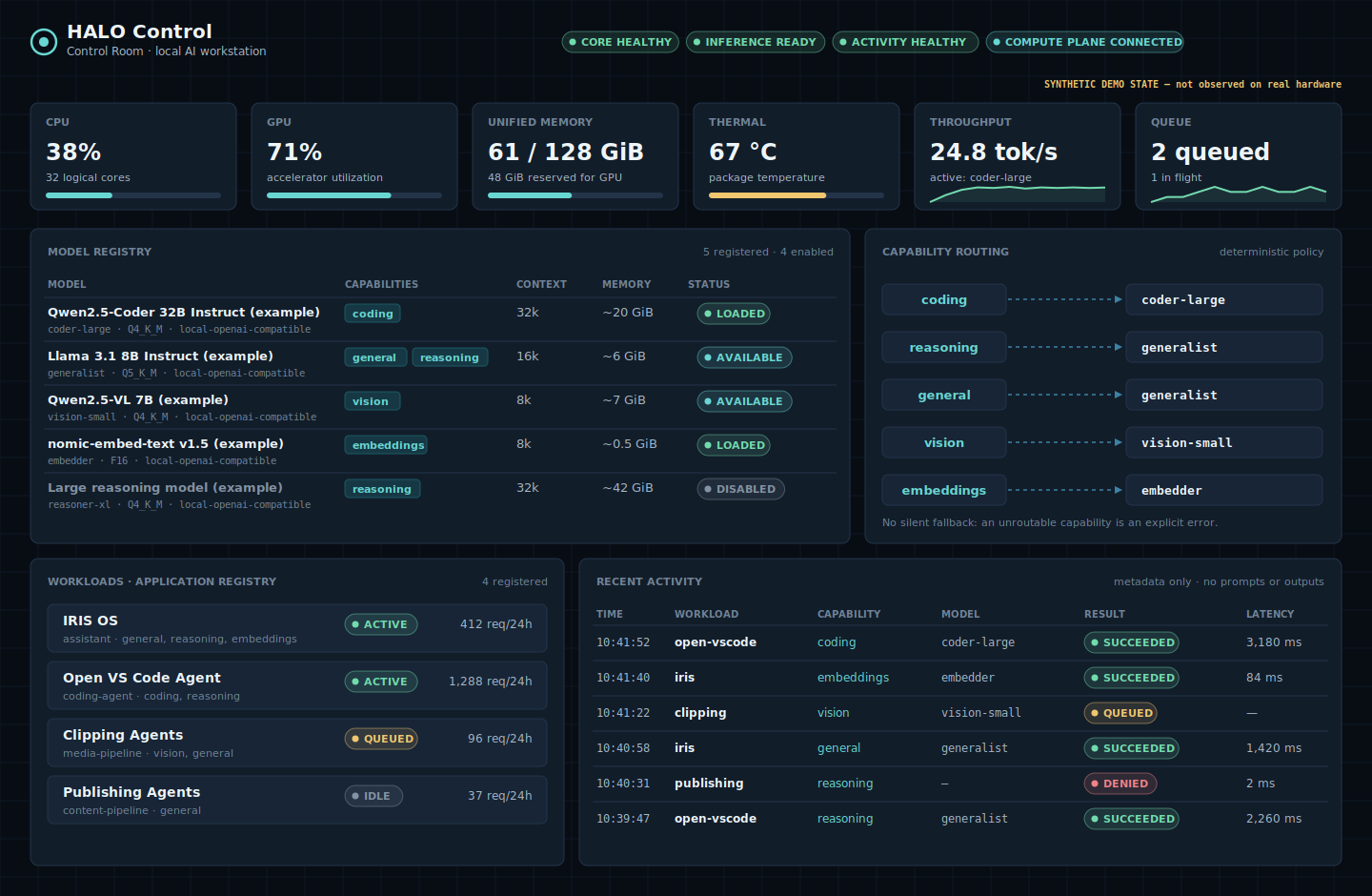
HALO puts a model registry and deterministic router between workloads and an OpenAI-compatible local runtime. A workload identifies itself, passes an authorization check, and asks for a capability such as coding or vision. An unroutable request returns an explicit error. Registration says what HALO knows about; it does not assert that a model is available.
03
Show the operator what is known
The Control Room brings model state, routing policy, registered workloads, and recent activity into one read-only view. Telemetry values carry an evidence class, so mocked, local-real, hardware-real, and unavailable signals cannot silently appear as equivalent measurements. The public screenshot uses synthetic fixtures and is labelled as such.
04
Implemented locally, published selectively
The repository documents an implemented headless control plane, deterministic routing, application authorization, SQLite activity history, a read-only Control Room, and a compute plane limited to registered services. It publishes architecture, illustrative contracts, one small routing demo, and synthetic examples. That public package is not the private runtime.
05
The hardware claim is still open
The published status does not verify a real model response through HALO or a run on the AMD Halo target machine. Resource-aware routing is a design goal represented by illustrative code. The case therefore describes the architecture and local implementation status without presenting the synthetic Control Room as operational proof.